Rethinking Quiet: The Total Noise Footprint of Electric Shavers
 Maya ChenContributing Editor
The search for the quietest electric shavers for morning routines typically ends with a list of premium rotary models. But here's the part nobody talks about: the quietest electric shavers often have the loudest cleaning stations, completely defeating the purpose of a silent morning routine. Evaluating a shaver based on its motor's decibel level alone ignores the disruptive, multi-minute cleaning cycle that can wake a household just as easily as a high-pitched foil shaver.
The Flaw in Decibel-Only Shaver Reviews
The conventional wisdom says premium models from Braun and Philips offer the quietest shave. While their motors are impressively engineered for low vibration, this view is incomplete. The primary feature of these high-end systems is often the included automated cleaning station. These bases, while convenient, introduce a secondary, and often much louder, source of noise. A typical cleaning program involves pumping fluid and running a fan, with noise levels that can approach that of a small kitchen appliance. As noted for premium models like the Braun Series 9 Pro, the full maintenance cycle includes cleaning, lubrication, and drying—a sequence far from silent. This automated noise is a separate issue from performance factors like how to prevent razor bumps from an electric shaver, but it is critical for household peace.
Manual Rinsing: The Consistent Path to Silence

Photo by https://kaboompics.com/ on Pexels
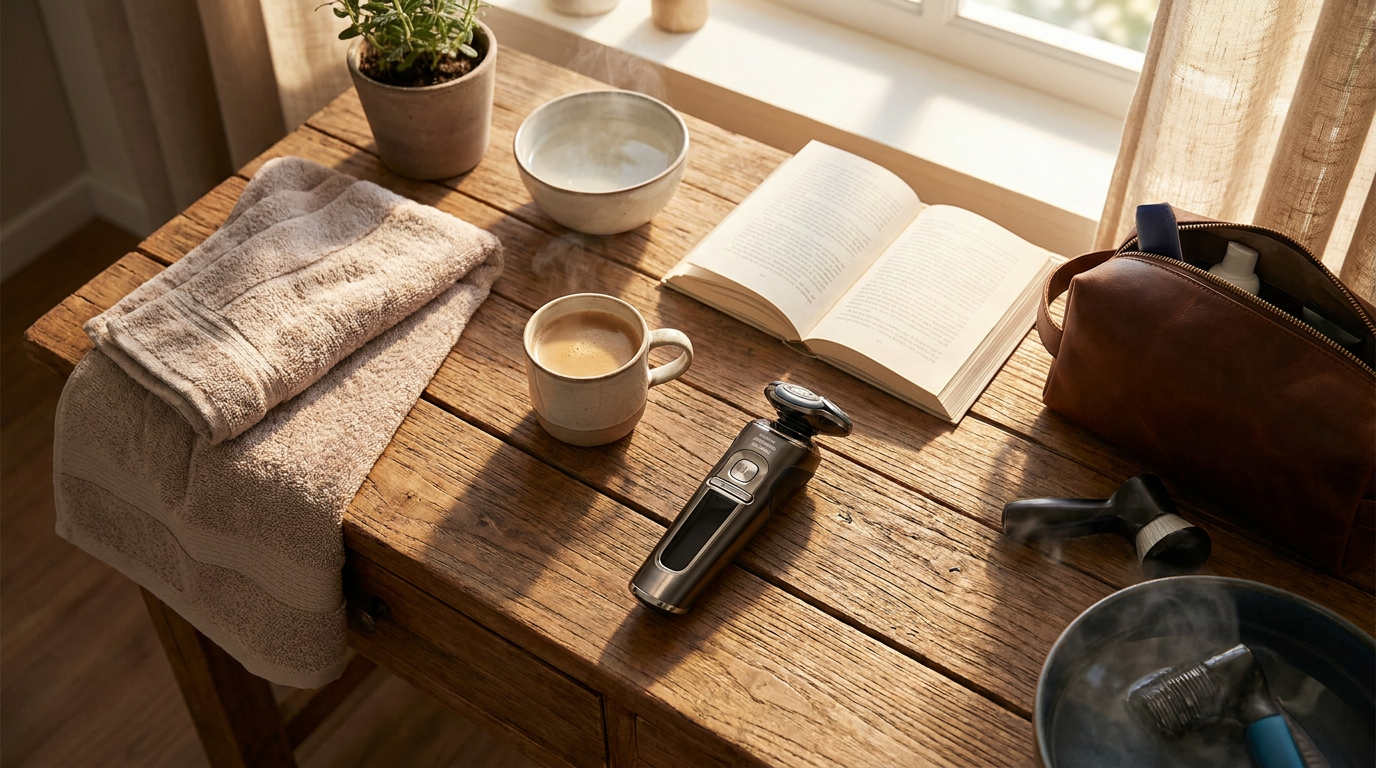
A more reliable strategy for a quiet morning is to prioritize shavers designed for simple manual cleaning. Models that are fully waterproof allow for a quick rinse under the tap, a process that takes less than a minute and generates minimal noise. This approach gives the user complete control over the entire grooming timeline and its associated sound. There is no risk of a cleaning station kicking on unexpectedly or running a loud drying fan for 40 minutes after you’ve left for work. The debate over self-cleaning vs. manual clean electric shavers often centers on hygiene, but the noise implication is the most overlooked factor. A manual rinse is predictably and consistently quiet.
Calculating the 'Total Noise Footprint'
To accurately assess a shaver's impact on a quiet home, one must consider its "total noise footprint." Run the math: a three-minute shave with a premium rotary shaver at 60 decibels is immediately negated by a five-minute cleaning cycle that hits 70-75 decibels. The true measure of a quiet shaver is the cumulative noise from the moment you pick it up to the moment it is clean and put away. For those who value a low-decibel environment, a slightly louder shaver motor that can be cleaned silently under a tap is functionally quieter than the premium "silent" model tied to a noisy base. This principle is even more critical when considering specialized use cases, such as selecting lightweight electric shavers for backpacking, where a bulky, noisy cleaning station is not an option.
Which is truly quieter: a premium shaver with a cleaning station or a mid-range model without one?

Photo by cottonbro studio on Pexels
A mid-range, waterproof model without a cleaning station offers a more consistently quiet experience. While its motor might be marginally louder during the shave itself, the absence of a noisy, automated cleaning cycle results in a significantly lower "total noise footprint." The entire process remains under the user's quiet control.
Does the type of motor (rotary vs. foil) still matter for noise?
The motor type is the primary factor for noise during the shave. Rotary shavers generally operate at a lower frequency and are perceived as quieter than high-vibration foil shavers. However, this analysis is meaningless if the shaver system includes a loud cleaning base. A quiet rotary shaver paired with a disruptive cleaning station can be worse for a quiet household than a slightly louder foil model that is cleaned manually in seconds.
I'll change my mind when manufacturers engineer cleaning stations that operate below 40 decibels, using technology that forgoes loud liquid pumps and high-speed fans. Until that standard is met, the quietest electric shaver system is one that embraces simple, manual rinsing.